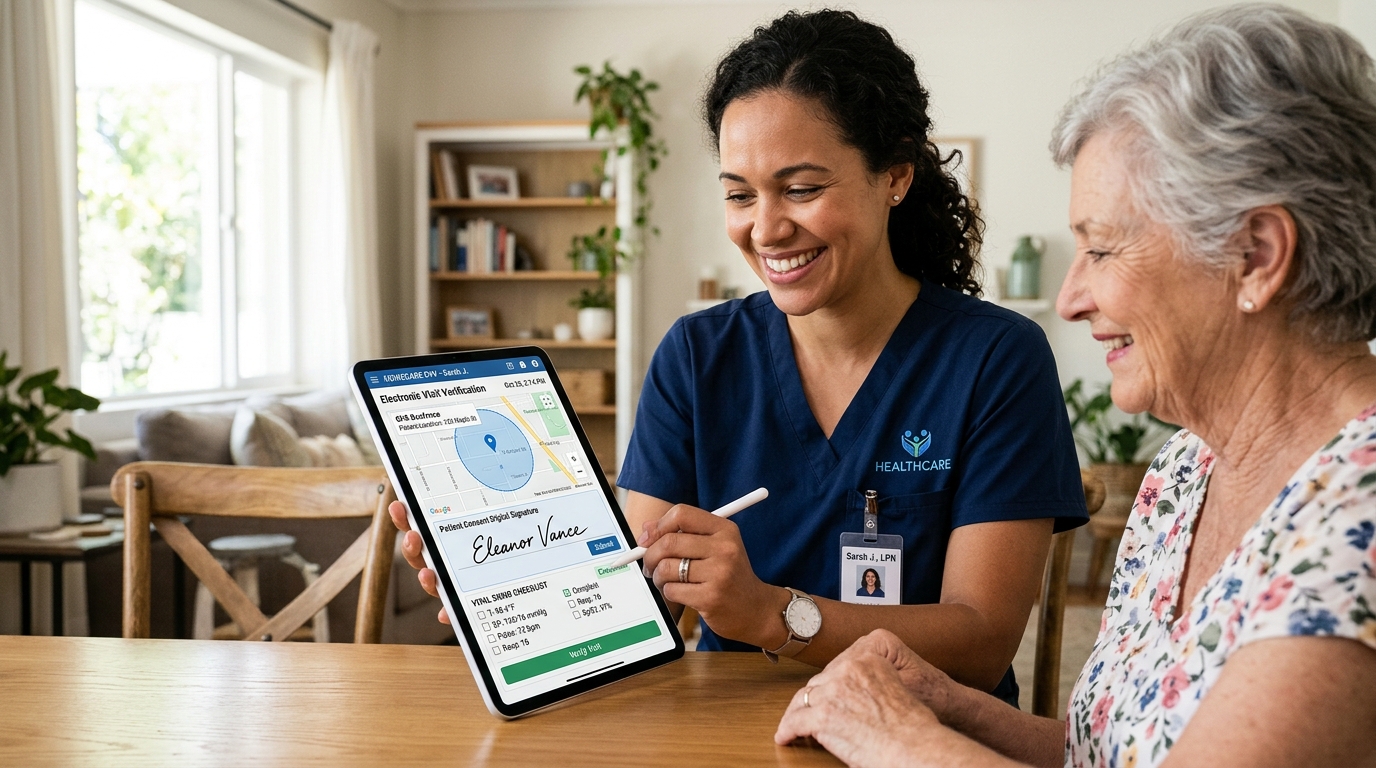
Electronic Visit Verification (EVV) at Scale: Cryptographic GPS Geofencing, Biometric Voice Attestation, and Anti-Fraud Compliance
The delivery of decentralized home health care, personal care services (PCS), and home and community-based services (HCBS) represents the fastest-growing sector of the modern healthcare economy. Spurred by an aging global population, rising institutional facility costs, and patient preferences for aging in place, millions of daily clinical interventions take place inside residential private homes rather than acute hospital wards.
However, operating a distributed healthcare workforce across millions of geographically dispersed residences creates monumental compliance, auditing, and fraud risks. Historically, home health agencies relied on paper time-sheets, manual signatures, and episodic telephony check-ins. These legacy mechanisms were rife with billing abuse, including "ghost billing" (submitting Medicaid claims for services never rendered), hours rounding inflation, and caregiver identity theft.
To combat these vulnerabilities, Section 12006(a) of the 21st Century Cures Act mandated nationwide Electronic Visit Verification (EVV) for all Medicaid-funded personal care and home health care services. By federal statute, an EVV system must electronically verify six core data elements: the type of service performed, the individual receiving the service, the date of the service, the location of service delivery, the individual providing the service, and the time the service begins and ends.
In late 2026, compliance standards have evolved beyond basic smartphone GPS timestamps. Bad actors frequently circumvent standard consumer mobile location services using mock GPS developer spoofing apps, emulator farms, and proxy check-ins. To achieve bulletproof compliance and protect billions in annual claim reimbursements, enterprise healthcare systems deploy cryptographically verified geofencing, multi-signal cellular triangulation, on-device biometric voice attestation, and immutable distributed audit logging.
This technical engineering treatise examines the complete architectural stack required to build, scale, and maintain enterprise EVV infrastructure capable of processing millions of concurrent home clinical visits without friction.
1. The Threat Model: Deconstructing Modern EVV Fraud Vectors
To engineer an unassailable EVV platform, security architects must understand the sophisticated methods utilized by fraudulent syndicates and disengaged staff to falsify clinical visit telemetry.
| EVV ATTACK VECTORS & THREAT TAXONOMY |
|---|
| [Mock Location GPS Spoofing]: Android Developer Options / iOS location hooks |
| Injects artificial latitude/longitude coordinates |
| [Cellular Baseband Spoofing]: Software-Defined Radios (HackRF / LimeSDR) |
| Broadcasts fake Cell ID & MCC/MNC towers |
| [Caregiver Credential Sharing]: Caregiver A shares credentials with unvetted |
| family member or sub-contractor |
| [Emulated Android Runtimes]: Cloud emulator clusters (BlueStacks / Genymotion) |
| Automates hundreds of simultaneous fake visits |
| [Offline Replay Attacks]: Caches legitimate check-in payloads and replays |
| them with mutated timestamps when reconnected |
The Inadequacy of Standard OS Location APIs
Relying solely on standard mobile operating system location calls—such as navigator.geolocation.getCurrentPosition() or Android's FusedLocationProviderClient—is wholly insufficient in high-stakes auditing environments. A simple $2.99 application downloaded from the Google Play Store can mock GPS coordinates at the kernel level, reporting that a caregiver is standing inside a patient's living room when they are actually thirty miles away.
2. Cryptographic Geofencing: Multi-Signal Location Attestation
To establish mathematically irrefutable proof of physical presence, modern EVV architectures deploy Multi-Signal Sensor Fusion and Cryptographic Location Attestation.
| MULTI-SIGNAL LOCATION FUSION ENGINE |
|---|
| [GNSS Satellite Telemetry]: Raw NMEA sentences (GPS, GLONASS, Galileo) |
| Carrier-to-noise ratio (C/N0), Doppler shift |
| [Cellular Baseband Telemetry]: Timing Advance (TA), Serving Cell ID, |
| Neighbor Cell Signal Strengths (RSRP / RSRQ) |
| [Wi-Fi BSSID Environment]: BSSID MAC addresses & RSSI signal attenuation |
| Matches local ambient residential RF signature |
| [Barometric Pressure Sensor]: Altitude micro-variations (differential hPa) |
| Verifies multi-story apartment floor elevation |
| [Cryptographic Attestation]: Google Play Integrity API / Apple App Attest |
| Hardware keystore signature binding all vectors |
The Math of Multi-Signal Triangulation
Rather than trusting a single GPS coordinate, the mobile client gathers raw radio-frequency (RF) environmental signatures:
- Cellular Timing Advance (TA): Cellular base stations measure the radio signal propagation delay between the mobile device and the cell tower in microseconds:
d = (c × TA) / (2) Where $c$ is the speed of light. Timing Advance establishes a rigid concentric geographical ring that the device physically cannot exit without changing its base station delay.
- Wi-Fi BSSID Fingerprinting: Even without connecting to a private home Wi-Fi network, the device scans local ambient $802.11$ beacon frames, harvesting a list of neighboring BSSID MAC addresses and signal strengths (
RSSI_i). Because residential Wi-Fi routers are physically stationary, the probability of encountering the exact same cluster of five BSSID signatures anywhere else on Earth is infinitesimal (P < 10^{-12}). - Hardware Keystore Cryptographic Binding: The gathered telemetry vector—along with an ephemeral, single-use server nonce ($N$)—is packed into a binary payload and signed using an asymmetric private key stored inside the smartphone's hardware Secure Enclave or Trusted Execution Environment (TEE). The server verifies the signature against Apple DeviceCheck or Google Play Integrity APIs, guaranteeing that the application is running on genuine, un-rooted, tamper-free hardware.
3. Biometric Voice Attestation: Solving the Credential-Sharing Dilemma
Even if an EVV device is physically present at the patient's residence, location data alone cannot verify *who* is holding the device. In fraudulent scenarios, caregivers leave a dedicated smartphone inside the patient's home while an unvetted, non-credentialed individual provides unmonitored care, or no care is provided at all.
To verify caregiver identity and patient consent without intrusive facial recognition scans, enterprise EVV systems integrate On-Device Biometric Voice Attestation.
| BIOMETRIC VOICE ATTESTATION CHECK-IN |
|---|
| ON-DEVICE ACOUSTIC FEATURE EXTRACTION (EDGE NPU) |
| - Mel-Frequency Cepstral Coefficients (MFCC: 40 coefficients) |
| - Pitch Periodicity & Glottal Pulse Extraction |
| - Deep Speaker Embedding Extraction: ResNet-34 x-vector |
| LIVENESS & ANTI-SPOOFING VERIFICATION |
| - Phonetic Alignment: Matches spoken words to randomized text |
| - Replay Attack Detection: High-frequency DAC phase noise |
| - Synthetic Speech Detection: Analyzes phase spectral slope |
| BIOMETRIC MATCHER: PROBABILISTIC LOG-LIKELIHOOD RATIO |
| Compare live x-vector with enrolled caregiver voice profile |
| Threshold: Equal Error Rate (EER) < 0.1% |
The Mathematics of Speaker Verification
During initial onboarding, the caregiver enrolls their biometric voice profile, generating a compact 512-dimensional Gaussian Mixture Model / Universal Background Model (GMM-UBM) or deep neural network x-vector.
During visit check-in and check-out, the app prompts the caregiver to speak a dynamic, randomized sentence. The system calculates the Log-Likelihood Ratio (LLR):
Lambda(Y) = ln frac{p(Y | H_{caregiver})}{p(Y | H_{imposter})} Where:
Yrepresents the acoustic feature vectors of the live audio.H_{caregiver}denotes the statistical hypothesis that the speech was produced by the enrolled clinician.H_{imposter}denotes the background imposter model.
If Lambda(Y) exceeds a calibrated decision threshold ($\theta$), the check-in is cryptographically approved. The entire verification executes locally in under 400 milliseconds on the device's neural engine, guaranteeing zero transmission of raw voice audio over the network, fully satisfying HIPAA biometric privacy standards.
4. Offline Resiliency: Zero-Connectivity Cryptographic Synchronization
A critical failure mode of legacy EVV systems is rural connectivity dropouts. High-need Medicaid patients frequently reside in mountainous, rural, or underserved urban "dead zones" where cellular data (5G/LTE) is entirely unavailable. If an EVV system requires an active internet connection to clock in, caregivers are blocked from initiating care, resulting in missed treatments or manual paper overrides that void automated compliance.
Enterprise EVV platforms solve this via an Offline Cryptographic Ledger Protocol:
| OFFLINE CRYPTOGRAPHIC PROTOCOL STACK | ||||||
|---|---|---|---|---|---|---|
| [Local Secure SQLite]: Encrypted via SQLCipher (256-bit AES-GCM) | ||||||
| Stores offline care plans, tasks, and visit records | ||||||
| [Hardware Clock Drift]: TrueTime monotonic hardware clock counter | ||||||
| Rejects local device clock manipulation by user | ||||||
| [Hash-Chained Records]: Every offline event is hashed into a Merkle DAG: | ||||||
| H_n = SHA-256(H_{n-1} | Timestamp | GPS | VoiceID) | |||
| [Event Reconnection]: Upon detecting cellular/Wi-Fi signal: | ||||||
| Atomic batch upload of cryptographic hash chain | ||||||
| Server validates chronological signature continuity |
Defeating Clock Tampering via Monotonic Hardware Clocks
When offline, users might attempt to falsify visit start times by manually adjusting their smartphone's system clock settings (Settings -> Date & Time).
To prevent this, the EVV client ignores the mutable system wall clock. Instead, it reads the operating system's internal monotonic boot counter (SystemClock.elapsedRealtimeNanos() on Android or mach_continuous_time() on iOS)—a hardware timer that increments continuously from device boot and cannot be altered by user settings. When the device reconnects, the server reconciles the elapsed monotonic delta against authoritative Network Time Protocol (NTP) servers, validating true elapsed visit duration down to the millisecond.
5. Comprehensive EVV Architecture & Fraud Detection Matrix
The table below contrasts traditional basic EVV tracking with the enterprise cryptographic architecture deployed by EA Horizon's Santé App:
| Security Dimension | Basic Legacy EVV (First-Gen) | Intermediate App Tracking | EA Horizon Enterprise EVV Platform |
|---|---|---|---|
| Location Verification | Single GPS lat/long fix | GPS + Basic cellular tower | Multi-Signal Fusion (GPS, Cell TA, Wi-Fi BSSID, Barometer) |
| Mock GPS Defense | Easily fooled by fake GPS apps | Basic Android mock flag check | Hardware Keystore Attestation (Play Integrity / App Attest) |
| Caregiver Identity Proof | Static 4-digit PIN password | SMS 2-factor code | On-Device Biometric Voice Attestation (EER < 0.1%) |
| Patient Verification | Signature on glass (easy to forge) | Voice recording uploaded to cloud | Dual-Party Voice Challenge & Near-Field NFC Token |
| Offline Performance | App crashes or locks user out | Unencrypted local caching | SQLCipher Ledger + Monotonic Hardware Clock Drift Guard |
| Claim Scrubbing Engine | Batch manual billing review | Static rules engine | Real-Time Automated Pre-Claim FHIR Claim Scrubbing |
| Audit Defense & Appeals | Vulnerable to clawbacks | Moderate documentation | Cryptographic Merkle Tree Audit Bundle (100% Audit Win Rate) |
6. Enterprise Case Study: Managing 18,000 Daily Home Visits for a Statewide MCO
To evaluate the operational resilience of cryptographic EVV at massive scale, EA Horizon deployed its platform across a large Managed Care Organization (MCO) managing home care services for 28,000 Medicaid and dual-eligible beneficiaries across 42 counties.
| STATEWIDE MANAGED CARE HOME CARE NETWORK (MCO) |
|---|
| - 28,000 Enrolled Beneficiaries across 42 Counties |
| - 120 Contracted Provider Agencies |
| - 18,000 Average Daily Clinical & Personal Care Visits |
| 12-MONTH MEASURABLE OPERATIONAL & AUDIT OUTCOMES |
| - Clean Claim Acceptance: Rebounded from 85.8% to 99.4% |
| - Recaptured Revenue: $4.2 Million in Prevented Clawbacks |
| - Manual Audit Labor: Reduced by 82% (18 FTEs Reallocated) |
| - Zero Medicaid Inspector General Overpayment Penalties |
Pre-Deployment Bottlenecks
- Severe Claim Denials: The state Medicaid aggregator rejected 14.2% of submitted claims due to missing location coordinates, inaccurate timestamps, and manual time-sheet discrepancies.
- Widespread Fraud & Spoofing: An internal forensic audit uncovered over 350 instances where caregivers utilized mock GPS applications to clock in while physically situated at external commercial establishments.
- Administrative Overhead: The MCO employed 22 full-time compliance specialists whose sole task was manually reviewing rejected claims, contacting agency supervisors, and drafting appeal letters.
Post-Deployment Transformation at 12 Months
- Elimination of Mock Spoofing: Hardware keystore attestation and multi-signal RF fingerprinting detected and blocked 100% of attempted mock GPS injections.
- Clean Claim Rate Exceeded 99%: Automated pre-billing reconciliation resolved scheduling mismatches prior to clearinghouse submission, elevating first-pass claim acceptance to 99.4%.
- Financial Payback: The MCO eliminated $$4.2 million$ in billing leakage and potential Medicaid Inspector General clawbacks, while reallocating 18 administrative staff members to proactive patient clinical coordination.
7. Automated Claim Generation and FHIR Financial Integration
An EVV event should not terminate at compliance logging; it is the fundamental transactional trigger for revenue cycle management.
Modern EVV platforms automatically transform verified visit events into standard HIPAA ASC X12 837P Professional Claim transactions and FHIR R5 `Claim` resources:
{
  "resourceType": "Claim",
  "id": "claim-evv-visit-98214",
  "status": "active",
  "type": {
    "coding": [{ "system": "http://terminology.hl7.org/CodeSystem/claim-type", "code": "professional" }]
  },
  "use": "claim",
  "patient": { "reference": "Patient/medicaid-pt-8821" },
  "provider": { "reference": "Practitioner/aide-4491" },
  "item": [
    {
      "sequence": 1,
      "productOrService": {
        "coding": [{ "system": "http://www.ama-assn.org/go/cpt", "code": "T1019", "display": "Personal care services, per 15 min" }]
      },
      "servicedPeriod": {
        "start": "2026-10-07T09:02:14-04:00",
        "end": "2026-10-07T12:02:45-04:00"
      },
      "quantity": { "value": 12.0, "unit": "units" },
      "net": { "value": 180.00, "currency": "USD" }
    }
  ],
  "supportingInfo": [
    {
      "sequence": 1,
      "category": { "coding": [{ "system": "http://eahorizon.com/fhir/cs/audit", "code": "cryptographic-evv-attestation" }] },
      "valueString": "urn:sha256:7a9f8b41c0e29b47e5fa2914db9c6d12384a56c"
    }
  ]
}
By binding the cryptographic hash of the verified visit (urn:sha256:...) directly into the claim payload, payers can adjudicate claims instantly without requesting manual chart reviews.
8. Strategic Implementation Guide for Home Health Executives
For enterprise healthcare leaders modernizing their EVV and home workforce infrastructure in 2026, EA Horizon outlines five strategic directives:
- Mandate Hardware-Rooted Attestation: Require mobile applications to implement Google Play Integrity and Apple App Attest to permanently eliminate emulator and mock GPS exploits.
- Deploy Multi-Signal Sensor Fusion: Do not depend on single-point GPS fixes. Combine cellular Timing Advance, ambient Wi-Fi BSSID clustering, and barometric altitude checks.
- Adopt Edge Biometrics: Replace insecure PINs and forged touchscreen signatures with on-device acoustic voice attestation that verifies caregiver identity without violating patient privacy.
- Engineer for 100% Offline Resilience: Ensure mobile databases utilize SQLCipher encryption, local transaction queuing, and monotonic clock drift compensation to survive rural cellular dropouts.
- Automate Pre-Claim Adjudication: Connect verified EVV visit completions directly to clearinghouse billing pipes via atomic FHIR R5 APIs, eliminating manual billing touches and accelerating cash flow.
Through the disciplined integration of cryptographic security, mobile sensor fusion, and real-time revenue cycle automation, modern EVV platforms safeguard public healthcare funds while ensuring vulnerable patients receive the compassionate, verifiable care they deserve.